
AR vs AI Virtual Try-On: Which One Is Better for Fashion Brands?
Which tech earns your bet?
9/27/20253 min read
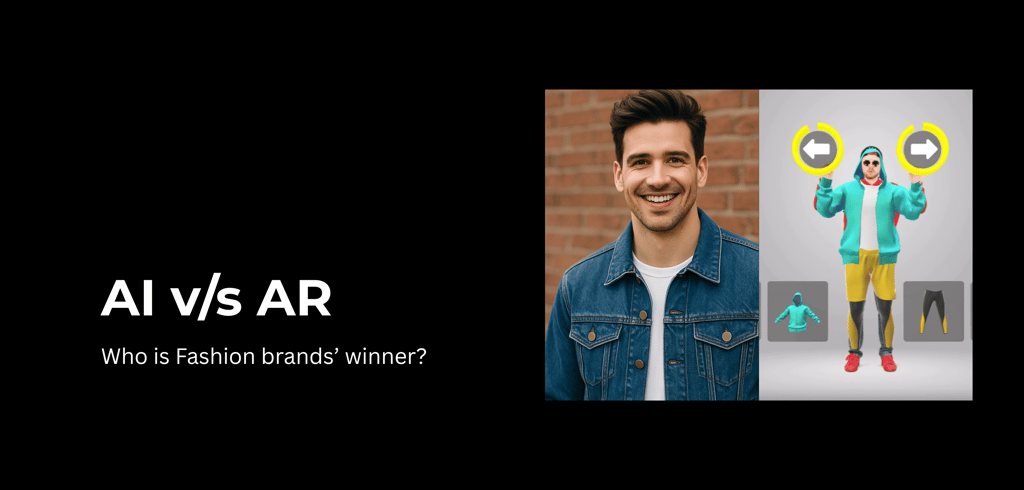

Fashion ecommerce is evolving at breakneck speed. With customer expectations rising, simply offering static product photos is no longer enough. Shoppers want confidence, personalization, and fun when making purchase decisions. That’s why Virtual Try-On (VTO) has become a hot topic in the fashion industry.
But here’s the dilemma:
Should brands invest in Augmented Reality (AR) try-ons or AI-powered image-based try-ons?
Both technologies are reshaping how consumers shop, yet they differ in execution, scalability, and results. In this article, we’ll break down AR vs AI virtual try-on, compare their advantages and limitations, and explain why AI may be the smarter long-term choice for fashion brands.
What Is AR Virtual Try-On?
Augmented Reality (AR) virtual try-on overlays digital clothing or accessories onto a customer’s live camera feed. Shoppers can “see” how a dress, glasses, or sneakers look on them in real-time.
Examples include:
Sephora’s Virtual Artist app for cosmetics
Warby Parker’s AR try-on for glasses
Nike’s AR sizing tool for shoes
How it works: Customers use their smartphone camera, and the AR software projects a 3D-rendered version of the product onto their face, feet, or body.
What Is AI Virtual Try-On?
AI-based virtual try-on uses artificial intelligence to realistically place clothing or accessories onto a customer’s uploaded image. Instead of live camera overlays, it leverages deep learning and computer vision to generate photo-realistic results.
Examples include:
Zalando’s AI-powered fitting room pilot
Vue.ai’s AI model try-on tech
Rupantar.ai pushes this further by letting shoppers instantly see how a dress, top, or pants looks on their body without complex 3D modeling, making it more scalable for fashion brands of all sizes.
AR vs AI Virtual Try-On: A Direct Comparison
Let’s break down the differences across key dimensions:
1. Accuracy & Realism
AR: Depends on device camera quality and calibration. Clothing often appears floating or misaligned, especially for complex garments. Works better for accessories (glasses, hats, sneakers).
AI: Learns from thousands of body and fabric datasets to deliver photo-realistic draping and fitting. Clothing looks like it’s actually worn, not pasted on.
👉 Winner: AI — especially for apparel where fit visualization matters most.
2. Device Compatibility
AR: Requires strong smartphone processing power and specific sensors. Not all users have AR-ready devices. According to Statista, only around 1.4 billion smartphones are AR-capable out of 6.8 billion total smartphones.
AI: Works on any device with internet access — customers just upload a photo.
👉 Winner: AI — higher accessibility means more users can actually try products.
3. Ease of Integration for Brands
AR: Needs 3D product modeling, which is expensive and time-consuming. Each new SKU requires rendering, slowing catalog digitization.
AI: Uses 2D images of garments (the same photos brands already take for product listings) and applies them to models or user photos with minimal effort.
👉 Winner: AI — far more scalable for fast-moving fashion collections.
4. Engagement & Interactivity
AR: Offers a “fun factor” with real-time movement. Great for marketing campaigns, Snapchat filters, and social sharing.
AI: Less “gamified” but more decision-driven. Shoppers try multiple outfits, colors, and fits privately — then save and share their favorite looks with friends before buying.
A report by Klarna found that 63% of Gen Z shoppers send screenshots of products to friends before purchasing, which makes AI-generated outfit previews perfect for social influence loops.
👉 Winner: AI — AI is better for serious buying intent, but AR is just for buzz.
5. Impact on Conversion & Returns
AR: Improves engagement, but accuracy issues limit its impact on returns. Sephora saw more app downloads, but didn’t report significant reductions in return rates.
AI: Drives higher conversions by improving buyer confidence. Zalando reported lower returns in trials of AI-powered fitting rooms.
👉 Winner: AI — proven impact on reducing returns and boosting revenue.
6. Cost & Scalability
AR: High setup cost due to 3D modeling + device dependency. Works better for brands with smaller catalogs.
AI: Cost-efficient because it scales across entire catalogs with just flat product photos. Perfect for brands with hundreds of SKUs.
👉 Winner: AI — rapid scaling and ease of implementation.
Why AI Virtual Try-On Is the Future
Device Agnostic → Works for all users, not just those with AR-ready phones.
Highly Scalable → No need for expensive 3D renders for each SKU.
Conversion-Focused → Realistic visualization directly impacts sales.
More Inclusive → Works across diverse body types and demographics.
Faster Go-To-Market → Perfect for fashion brands launching new collections quickly.
RUPANTAR AI is leading this transition, helping fashion brands deploy AI-based try-on seamlessly within their ecommerce stores, reducing both customer hesitation and operational costs.
Final Verdict: AI Wins for Long-Term Brand Growth
While AR virtual try-on is fun, engaging, and useful for niche categories, it has limitations in accuracy, accessibility, and scalability.
AI-powered virtual try-on, on the other hand, is future-ready, conversion-driven, and sustainable — making it the clear winner for fashion brands serious about ecommerce growth.
👉 If your goal is to increase conversions, reduce returns, and create a seamless digital fitting room for all shoppers, AI virtual try-on is the smarter investment.on seamlessly within their ecommerce stores, reducing both customer hesitation and operational costs.
Fashion brands adopting AI-driven virtual try-on today will lead tomorrow’s ecommerce revolution.
Curious to see how it could work for your brand?
RUPANTAR AI — can turn your online store into a true digital fitting room. Reach out to us on Instagram / Linkedin / Contact Us and we’ll guide you further.